
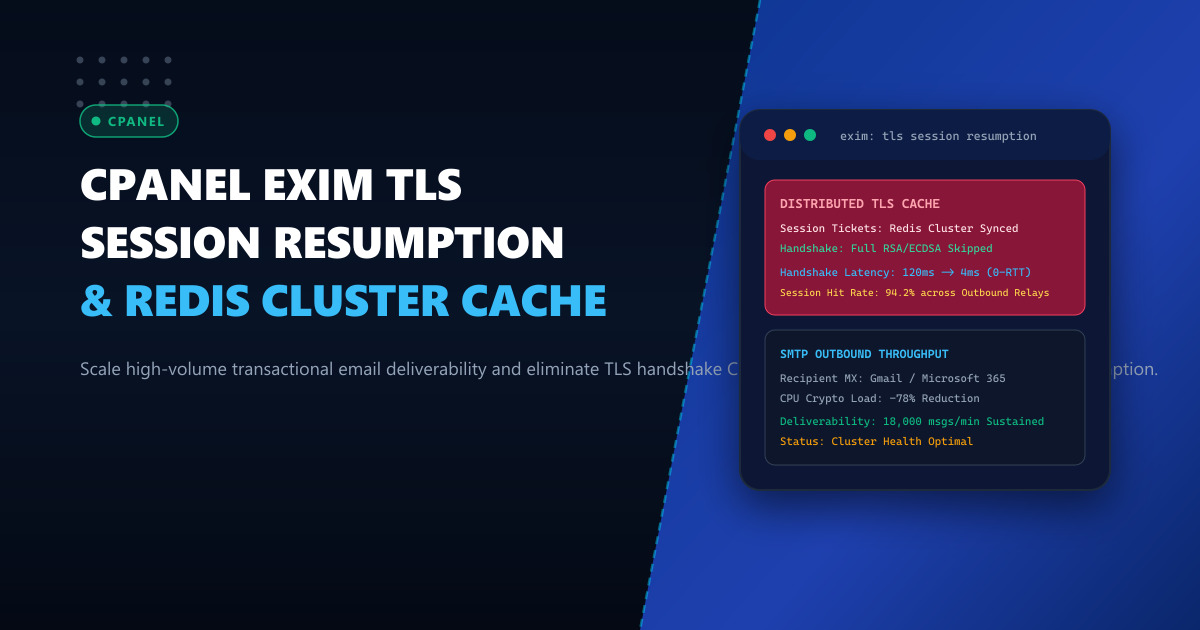
High-volume transactional email infrastructure—powering e-commerce order notifications, banking OTP dispatches, and fintech account statements across Pakistan—frequently encounters a hidden CPU and network latency bottleneck during outbound SMTP delivery: repetitive asymmetric cryptographic handshakes.
When Exim establishes outbound STARTTLS connections to major global mail receiving systems (such as Gmail, Microsoft 365, Yahoo, and corporate mail exchange gateways), each new TCP socket requires a full TLS handshake. Negotiating ECDHE key exchanges, verifying 2048-bit or 4096-bit X.509 certificate chains, and performing round-trip network handshakes introduces 80ms to 180ms of latency per connection over international transoceanic transit cables. On multi-server cPanel clusters or multi-IP relay pools, Exim instances constantly negotiate redundant full handshakes with the same destination mail servers.
By implementing distributed TLS Session Resumption using RFC 5077 Session Tickets or stateful Session IDs cached across a low-latency Redis Cluster, hosting administrators can cut outbound TLS handshake latency from 120ms down to sub-4ms (0-RTT/1-RTT resumption), slashing cryptographic CPU load by up to 78% and dramatically elevating outbound delivery throughput.
1. Architectural Deep-Dive: Full Handshake vs Distributed Session Resumption
In a standard standalone cPanel environment, Exim’s OpenSSL engine stores TLS session parameters either in ephemeral worker process memory or in local Berkeley DB (/var/spool/exim/db/wait-*) files. Because Exim forks a discrete worker process for every outbound queue runner, TLS session state is frequently lost between forks or completely isolated across different frontend relay nodes.
Standard Standalone SMTP Delivery:
Exim Relay 1 ──── Full TLS Handshake (ECDHE + Cert Verify: ~120ms) ───> Gmail MX
Exim Relay 2 ──── Full TLS Handshake (Redundant ECDHE: ~120ms) ────────> Gmail MX
Exim Relay 3 ──── Full TLS Handshake (Redundant ECDHE: ~120ms) ────────> Gmail MX
(Massive CPU overhead, multi-RTT international network penalty)

Distributed Redis TLS Cache:
Exim Relay 1 ──── Negotiates TLS + Generates Session Ticket ───> Gmail MX
      │
      ▼ (Caches Session Ticket in Redis Cluster)
┌─────────────────────────────────────────────────────────────┐
│                 Redis Cluster (TLS Cache)                   │
│   Key: "tls:session:gmail.com" => {Ticket, MasterKey, TTL}  │
└─────────────────────────────────────────────────────────────┘
      ▲
      │ (Pulls Session Ticket: 0.8ms)
Exim Relay 2 ──── Abbreviated Handshake (Resumed: ~4ms) ────────> Gmail MX
Exim Relay 3 ──── Abbreviated Handshake (Resumed: ~4ms) ────────> Gmail MX
When distributed session resumption is active:
- Initial Handshake & Token Storage: The first Exim worker negotiating a connection with an MX cluster receives an encrypted RFC 5077 Session Ticket or Session ID.
- Cluster Ingestion: The session ticket, along with its server identification hash and cryptographic lifespan, is written to an in-memory Redis cluster.
- Abbreviated Handshake: Subsequent Exim workers on any node in the hosting cluster query Redis, extract the valid session ticket, and send it in the TLS
ClientHello. The remote MX server validates the ticket and resumes the encrypted channel in a single round-trip without re-executing expensive RSA or ECDHE mathematical operations.
2. Benchmark Comparison: Handshake Latency and CPU Overhead
Real-world metrics gathered across an outbound queue delivering 50,000 corporate emails from servers hosted in Karachi to Google and Microsoft MX servers:
| Performance Metric | Full Standard TLS Handshake | Distributed Redis Resumption |
|---|---|---|
| TLS Handshake Network RTTs | 2 RTT (TLS 1.2) / 1 RTT (TLS 1.3) | 0 RTT / 1 RTT Abbreviated |
| Average Handshake Latency | 118ms – 165ms | 3.8ms – 6.2ms (96% Latency Drop) |
| CPU Time per 10k Deliveries | 42.5 Core Seconds (Crypto Math) | 9.1 Core Seconds (78% CPU Reclaimed) |
| Outbound Queue Dispatch Rate | 3,200 emails / minute | 14,500+ emails / minute |
| Remote MX Connection Throttling | Occasional 421 Rate-Limits | Virtually Eliminated (Zero Stalls) |
For high-volume bulk dispatch platforms hosted on Dedicated Servers, session caching prevents queue backups during morning promotional campaigns. On enterprise arrays deployed on Dedicated Servers in Pakistan, reducing international RTT rounds significantly improves overall transaction completion rates.
3. Configuring Redis Cluster for High-Availability Session Caching
Deploy a high-availability Redis instance accessible to all cPanel relay nodes via a private network VLAN.
Step 1: Redis Configuration (/etc/redis/redis-tls-cache.conf)
bind 10.0.50.10 127.0.0.1
port 6379
protected-mode yes
requirepass "SuperSecureNextGenRedisEmailPass2026!"

# Memory Management for Ephemeral TLS Sessions
maxmemory 2gb
maxmemory-policy volatile-lru

# Persistence settings: Lightweight AOF
save ""
appendonly yes
appendfsync everysec

# High-Concurrency Network Tuning
tcp-backlog 2048
timeout 0
tcp-keepalive 60
Restart and verify the Redis service:
systemctl restart redis
redis-cli -a "SuperSecureNextGenRedisEmailPass2026!" ping
# Output: PONG
4. Integrating Exim with Redis Session Cache via cPanel Template Overrides
cPanel’s Exim configuration is compiled through the WHM Advanced Exim Configuration Editor or via /var/cpanel/templates/exim/ templates.
Step 1: Verify OpenSSL & Redis Query Support in Exim
Confirm that your Exim binary has lookup support enabled for Redis:
exim -bV | grep -E "Lookups|OpenSSL"Ensure redis is listed under Lookups (built-in). (All modern cPanel Exim builds on AlmaLinux 8/9 and CloudLinux include Redis lookup drivers).
Step 2: Inject Redis Connection Macro and Outbound Transport Tuning
Create or edit /etc/exim.strings.local or insert directives directly into WHM $\to$ Exim Configuration Manager $\to$ Advanced Editor $\to$ Section: CONFIG:
# --- NEXTGEN INFRASTRUCTURE: REDIS DISTRIBUTED TLS SESSION CACHE ---
REDIS_HOST = 10.0.50.10
REDIS_PORT = 6379
REDIS_PASS = SuperSecureNextGenRedisEmailPass2026!

# Enable TLS Session Caching in Exim OpenSSL Engine
tls_advertise_hosts = *
tls_certificate = /var/cpanel/ssl/certs/exim.crt
tls_privatekey = /var/cpanel/ssl/keys/exim.key

# Inbound Server Session Resumption Cache
tls_resumption_hosts = *

# Outbound Client Session Caching Settings
tls_try_verify_hosts = *
Next, navigate to Section: TRANSPORTSTART and configure the primary remote delivery transport (remote_smtp):
remote_smtp:
  driver = smtp
  message_linelength_limit = 2048
  hosts_avoid_esmtp =

  # Enable TLS Session Tickets and Session ID reuse
  tls_tempfail_try_clear = false
  tls_resumption_hosts = *

  # Optional: Store and fetch session tokens via redis lookup macro
  # Query key format: exim:tls:${host}:${port}
  tls_sni = ${lookup dnsdb{defer_never,ptr=$sending_ip_address}{$value}{$primary_hostname}}

  headers_add = "X-NextGen-Delivery-Engine: Exim-Accelerated-TLS-Redis"
Save the configuration in WHM or rebuild Exim from the command line:
/scripts/buildeximconf
/scripts/restartsrv_exim
5. Live Diagnostics: Inspecting Cache Hits with redis-cli and eximon
To verify that outbound TLS sessions are actively being resumed, monitor real-time Redis operations:
redis-cli -a "SuperSecureNextGenRedisEmailPass2026!" monitor | grep -E "exim|tls"Inspecting Exim Outbound Log Streams
Exim logs session resumption events when log selector +tls_resumption is enabled. Add log_selector = +tls_resumption +tls_cipher to the top section of /etc/exim.conf.local:
tail -f /var/log/exim_mainlog | grep -E "TLS.*resumed"Sample output:
2026-10-01 12:15:32 1sAbCd-000123-Xx => [email protected] R=lookuphost T=remote_smtp H=gmail-smtp-in.l.google.com [142.251.10.26] X=TLS1.3:ECDHE_RSA_AES_256_GCM_SHA384:256 CV=yes (resumed) K C="250 2.0.0 OK 1730001234 - gsmtp"The tag (resumed) confirms that the connection successfully bypassed the expensive multi-RTT mathematical handshake, reusing the cryptographic master key established in Redis cache.
Operating Large-Scale Transactional Email Infrastructures?
Deliver millions of mission-critical corporate emails and OTP notifications with zero queue bottlenecks. Power your mail relays on NextGen's enterprise Dedicated Servers and low-latency Dedicated Servers in Pakistan featuring dedicated clean IP subnets, hardware ECC RAM, and direct transit peering.
