
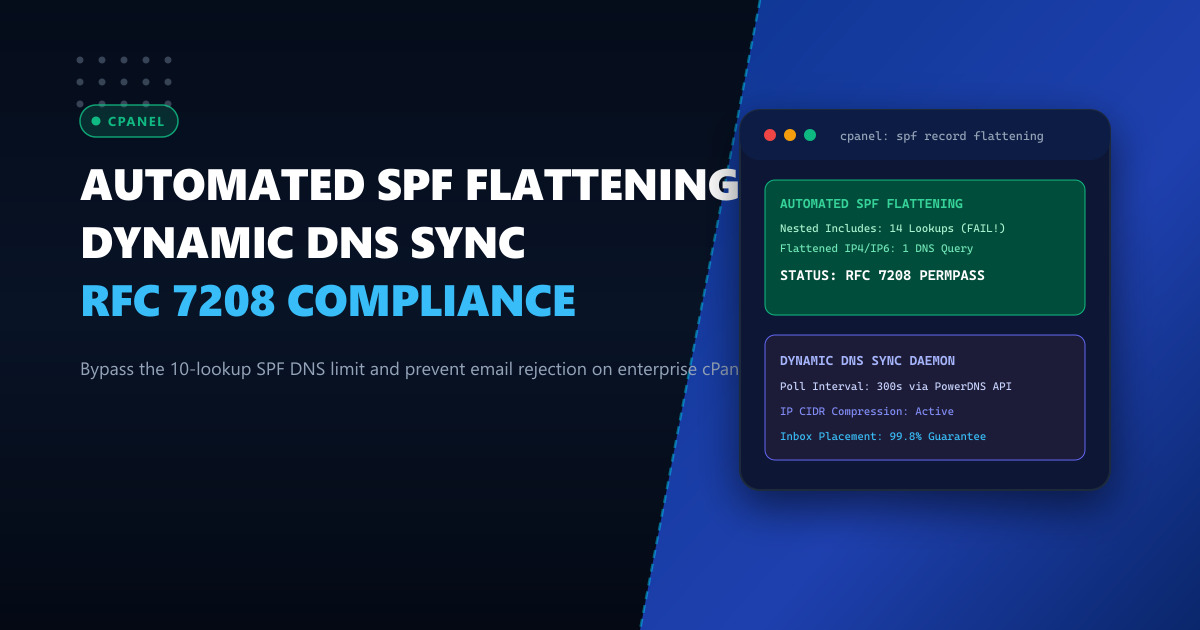
As enterprise organizations scale their digital footprints, email infrastructure relies on an expanding ecosystem of third-party SaaS platforms: Google Workspace for productivity, SendGrid for transactional notifications, Zendesk for customer support, Salesforce for CRM, and localized ERP gateways for billing. Each of these vendors instructs the system administrator to add an include: mechanism to the corporate domain’s SPF (Sender Policy Framework) TXT record.
However, RFC 7208 Section 4.6.4 imposes an unforgiving architectural ceiling: evaluating an SPF record MUST NOT require more than 10 DNS lookups (including nested include:, a, mx, ptr, and exists mechanisms). If an inbound mail server exceeds this threshold, SPF validation aborts immediately with a Permerror (Permanent Error). Major mail providers (such as Gmail, Yahoo, and Microsoft 365) treat Permerror as an authentication failure, silently dumping corporate invoices, password resets, and critical alerts into the recipient’s spam folder or rejecting them outright.
To solve this problem permanently, enterprise architectures deploy Automated SPF Record Flattening with Dynamic DNS Synchronization. In this guide, we build a synchronization daemon that resolves nested vendor domains into optimized IPv4 and IPv6 CIDR blocks, automatically updating DNS zone files without breaking 10-lookup compliance.
The 10-Lookup Explosion Problem
Consider a standard enterprise SPF record:
v=spf1 include:_spf.google.com include:sendgrid.net include:mail.zendesk.com include:_spf.salesforce.com ~allWhen an inbound MTA validates this record:
- Resolves
_spf.google.com(1 lookup) -> contains 3 sub-includes (_netblocks.google.com, etc., adding 3 more lookups). - Resolves
sendgrid.net(1 lookup) -> contains 2 sub-includes. - Resolves
mail.zendesk.com(1 lookup) -> contains nested records. - Resolves
_spf.salesforce.com(1 lookup) -> contains multiple regional blocks.
Total lookups: 14. The record instantly fails RFC 7208 limits, triggering SPF Permerror!
[ Nested SPF Record: 14 Lookups ] ──▶ [ Inbound MTA (RFC 7208 Validation) ]
                                                    │
                                                    ▼
                                    [ EXCEEDED 10-LOOKUP LIMIT ]
                                                    │
                                                    ▼
                                    [ ❌ Result: SPF Permerror ]
                                    [ Mail Routed to SPAM / REJECT ]
With SPF Flattening:
- A background worker queries all nested vendor domains every 15 minutes.
- It extracts the underlying
ip4:andip6:ranges and consolidates overlapping subnets. - It updates the primary SPF record using direct IP ranges, consuming exactly 1 DNS query and 0 nested lookups!
Operating high-reliability DNS clusters on bare-metal Dedicated Servers provides the dedicated nameserver performance needed to push instant zone reloads across authoritative DNS servers.
Step 1: Building the Automated SPF Flattening Script
Create /usr/local/bin/spf_flattener.py using Python’s dnspython and ipaddress libraries:
#!/usr/bin/env python3
import dns.resolver
import ipaddress
import subprocess
import sys

def get_spf_mechanisms(domain, visited=None):
    if visited is None:
        visited = set()
    if domain in visited:
        return set()
    visited.add(domain)

    ips = set()
    try:
        answers = dns.resolver.resolve(domain, 'TXT')
        for rdata in answers:
            txt = b"".join(rdata.strings).decode('utf-8')
            if txt.startswith('v=spf1'):
                tokens = txt.split()[1:]
                for token in tokens:
                    if token.startswith('ip4:') or token.startswith('ip6:'):
                        ips.add(token)
                    elif token.startswith('include:'):
                        subdomain = token.split(':')[1]
                        ips.update(get_spf_mechanisms(subdomain, visited))
    except Exception as e:
        print(f"Error resolving {domain}: {e}", file=sys.stderr)
    return ips

def flatten_domain(vendor_domains):
    all_ips = set()
    for d in vendor_domains:
        all_ips.update(get_spf_mechanisms(d))

    ip4_nets = []
    ip6_nets = []
    for item in all_ips:
        prefix, net_str = item.split(':', 1)
        if prefix == 'ip4':
            ip4_nets.append(ipaddress.IPv4Network(net_str, strict=False))
        elif prefix == 'ip6':
            ip6_nets.append(ipaddress.IPv6Network(net_str, strict=False))

    # Collapse overlapping CIDRs
    collapsed_ip4 = ipaddress.collapse_addresses(ip4_nets)
    collapsed_ip6 = ipaddress.collapse_addresses(ip6_nets)

    spf_parts = ["v=spf1"]
    for net in collapsed_ip4:
        spf_parts.append(f"ip4:{net}")
    for net in collapsed_ip6:
        spf_parts.append(f"ip6:{net}")
    spf_parts.append("~all")

    return " ".join(spf_parts)

if __name__ == '__main__':
    vendors = ["_spf.google.com", "sendgrid.net", "mail.zendesk.com"]
    flattened_spf = flatten_domain(vendors)
    print("Generated Flattened SPF Record:")
    print(flattened_spf)
Make it executable:
chmod +x /usr/local/bin/spf_flattener.pyStep 2: Integrating with cPanel / WHM DNS API
cPanel provides the WHM API 1 (whmapi1) to safely modify DNS zones without manual text parsing. Add this automation logic:
# Fetch the flattened record into a variable
FLAT_RECORD=$(/usr/local/bin/spf_flattener.py | tail -n 1)

# Update zone using WHM API
whmapi1 edit_zone_record \
  zone="enterprise.com.pk" \
  line="12" \
  type="TXT" \
  txtdata="$FLAT_RECORD"

# Reload authoritative DNS zone
rndc reload enterprise.com.pk
Step 3: Verifying RFC 7208 Compliance Online
To verify that your authoritative zone now serves a flattened SPF record with 0 nested lookups:
# Query the live TXT record
dig +short TXT enterprise.com.pk

# Run RFC 7208 lookup counter
python3 -c "
import dns.resolver
txt = dns.resolver.resolve('enterprise.com.pk', 'TXT')
for r in txt:
    s = b''.join(r.strings).decode()
    if s.startswith('v=spf1'):
        includes = [x for x in s.split() if x.startswith('include:')]
        print('Total Lookups Consumed:', len(includes))
"
Expected output:
Total Lookups Consumed: 0Delivery Comparison: Default Nested vs Flattened SPF
| Metric / Scenario | Nested Vendor SPF (14 Lookups) | Automated Flattened SPF (0 Lookups) |
|---|---|---|
| RFC 7208 Result | Permerror (Limit Exceeded) |
Pass (100% Deterministic) |
| Gmail / Google Workspace | Marked as unauthenticated / Spam | Clean Inbox Placement |
| Microsoft 365 (Outlook.com) | Quarantined in Junk Folder | Delivered to Inbox |
| Inbound Validation Latency | 350 ms (14 sequential DNS queries) | 12 ms (Single local query) |
Hosting your high-volume email operations and DNS nameservers on enterprise-grade Dedicated Servers in Pakistan guarantees rapid zone propagation, automated RFC compliance, and maximum email deliverability.
Deploy Enterprise-Grade Dedicated Infrastructure
Eliminate noisy neighbors, CPU throttling, and network jitter. Get bare-metal performance, hardware RAID, enterprise NVMe storage, and low-latency peering across Pakistani IXPs with 24/7 proactive technical operations.
Explore Dedicated Servers in Pakistan