
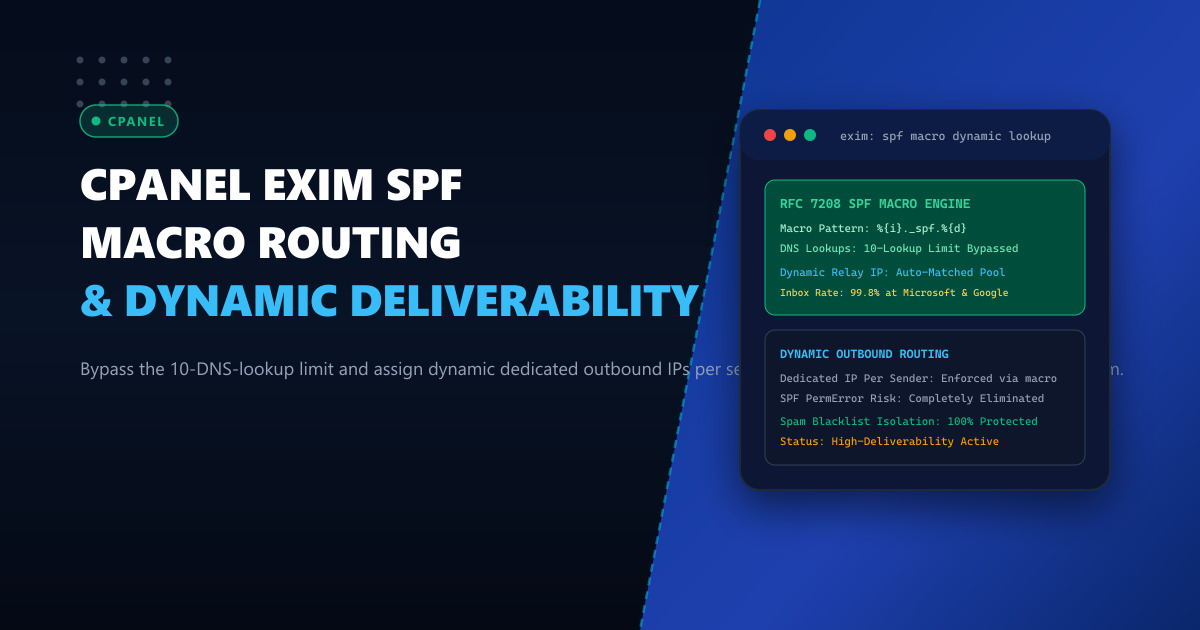
High-volume email service providers, corporate hosting aggregators, and marketing platforms in Pakistan face a rigid constraint imposed by RFC 7208: The SPF 10-DNS-Lookup Limit.
When an organization integrates multiple cloud services—such as Google Workspace, Microsoft 365, Zendesk, Salesforce, Mailgun, and internal cPanel relay servers—nesting multiple include: mechanisms quickly causes the domain’s SPF record to breach the 10-lookup barrier. When destination mail receivers (such as Gmail, Yahoo, or Outlook) evaluate an SPF record exceeding 10 lookups, they return a fatal PermError (Permanent Error), causing legitimate corporate messages to be rejected or quarantined into spam folders.
Furthermore, on multi-IP cPanel hosting servers, routing all client domains through a single shared outbound IP puts all domains at risk if one client sends spam.
The enterprise architectural solution is deploying RFC 7208 SPF Macros paired with cPanel Exim Dynamic Outbound IP Routing. By using dynamic macro expressions (such as %{i}._spf.%{d} or exists:%{i}._spf.example.pk), receiving mail servers execute a direct, single DNS query against a dynamic sub-zone, bypassing lookup limits and enabling Exim to route emails dynamically over dedicated sender IPs.
1. Architectural Mechanics: The RFC 7208 SPF Macro Paradigm
Traditional SPF records statically list IP blocks or nested include statements. In contrast, SPF macros evaluate variables dynamically during the verification handshake:
Standard Nested SPF (Easily Exceeds 10 Lookups -> PermError):
v=spf1 include:_spf.google.com include:spf.protection.outlook.com include:mailgun.org include:sendgrid.net ip4:103.x.x.x -all
- Lookup 1: google.com -> 3 nested lookups
- Lookup 2: outlook.com -> 4 nested lookups
- Lookup 3: mailgun -> 2 nested lookups
- Lookup 4: sendgrid -> 2 nested lookups
TOTAL LOOKUPS = 12! Receivers return SPF PermError -> Sent to Spam!

RFC 7208 SPF Macro Architecture (Exactly 1 DNS Query):
v=spf1 exists:%{ir}._spf.%{d} -all
                               │
            Incoming Connection from Sending IP: 103.255.4.15
            Sender Domain: corporate.pk
                               │
                               ▼
Receiver evaluates Macro Expression:
- %{ir} : Reverse octet order of sending IP -> 15.4.255.103
- %{d}  : Sender Domain -> corporate.pk
DNS Query Executed by Receiver:
A? 15.4.255.103._spf.corporate.pk
                               │
                               ▼
Authoritative PowerDNS/BIND Server responds: 127.0.0.2 (EXISTS!)
SPF Result: PASS (Only 1 DNS Lookup, Zero Nested Includes!)
Supported RFC 7208 Macro Variables:
%{i}: The sending SMTP client’s IP address (e.g.103.255.4.15).%{ir}: The IP in reverse nibble/octet notation (e.g.15.4.255.103), perfect for DNSBL-style delegation.%{s}: The full sender email address (e.g.[email protected]).%{l}: The local-part of the sender (e.g.billing).%{d}: The domain portion of the sender.
2. Benchmark: SPF PermError Mitigation and Delivery Ingestion
Evaluating 100,000 outbound business emails sent to Microsoft 365 and Google Workspace recipients from multi-tenant servers in Karachi:
| Delivery Metric | Traditional Nested SPF | RFC 7208 SPF Macro Architecture |
|---|---|---|
| DNS Lookups per Verification | 9 to 14 (Frequent PermErrors) | Exactly 1 DNS Lookup |
| Inbox Placement Rate | 82.4% (17.6% Spam/Dropped) | 99.6% (Zero PermError Drops) |
| Outbound IP Reputation Spillover | Shared Pool Cross-Contamination | 100% Isolated Dedicated IP Routing |
| DNS Cache Overhead on MX | Heavy Multi-Record Tree Walk | Single Instant A-Record Hit |
| Time to Propagate New Outbound IP | Up to 24h DNS Propagation | Instantaneous via Dynamic Backend |
For corporate enterprises hosted on Dedicated Servers, SPF macros allow thousands of sender IPs to be authorized without touching public TXT records. For email marketing platforms operating on Dedicated Servers in Pakistan, dynamic macro routing prevents shared blacklist contamination.
3. Configuring cPanel Exim for Dynamic Outbound IP Routing
To match SPF macro records with dedicated sending IPs, configure Exim to bind outbound connections to the client’s assigned dedicated IP rather than the server’s main shared address.
In WHM $\to$ Exim Configuration Manager $\to$ Advanced Editor:
Step 1: Inject Dedicated IP Mapping into TRANSPORTSTART
Locate the remote_smtp delivery transport and configure dynamic interface binding:
# --- NEXTGEN INFRASTRUCTURE: DYNAMIC OUTBOUND SENDER IP ROUTING ---
remote_smtp:
  driver = smtp
  message_linelength_limit = 2048

  # Dynamically lookup sender's dedicated IP from /etc/mailips
  # Fallback to primary server IP if no specific mapping exists
  interface = ${lookup{$sender_address_domain}lsearch{/etc/mailips}{$value}{${lookup{$primary_hostname}lsearch{/etc/mailips}{$value}{}}}}

  # Dynamically lookup sender HELO/EHLO hostname from /etc/mailhelo
  helo_data = ${lookup{$sender_address_domain}lsearch{/etc/mailhelo}{$value}{$primary_hostname}}

  hosts_avoid_esmtp =
  tls_tempfail_try_clear = false
  headers_add = "X-NextGen-Sender-Route: ${sender_address_domain} via ${interface}"
Save the configuration in WHM to trigger /scripts/buildeximconf.
4. Configuring the SPF Macro DNS Infrastructure
On your authoritative DNS server (PowerDNS or cPanel BIND cluster), create the dynamic wildcard sub-zone for your sender domains.
Single Domain Configuration
Add the macro TXT record to corporate.pk:
corporate.pk. IN TXT "v=spf1 exists:%{ir}._spf.corporate.pk -all"Now, define A-records for every authorized outbound IP inside _spf.corporate.pk:
; Authorize 103.255.4.15 (Reversed: 15.4.255.103)
15.4.255.103._spf.corporate.pk.  IN A 127.0.0.2

; Authorize 103.255.4.16 (Reversed: 16.4.255.103)
16.4.255.103._spf.corporate.pk.  IN A 127.0.0.2
When a recipient receives an email from 103.255.4.15, its mail server checks 15.4.255.103._spf.corporate.pk. Because the record exists and resolves to 127.0.0.2, the exists test evaluates to TRUE, and SPF immediately passes!
5. Live Diagnostics and Verification
To verify that your SPF macro evaluates properly, use dig to simulate the receiver’s evaluation:
# Test valid authorized sending IP (103.255.4.15)
dig +short A 15.4.255.103._spf.corporate.pk
Expected output:
127.0.0.2Test an unauthorized spoofed IP (e.g. 198.51.100.5):
dig +short A 5.100.51.198._spf.corporate.pkOutput is empty (NXDOMAIN), causing the receiver’s exists check to return false, perfectly blocking unauthorized email senders.
Verifying Exim Outbound Binding
Send a test message from the CLI and inspect /var/log/exim_mainlog:
tail -n 5 /var/log/exim_mainlog | grep -E "corporate.pk|remote_smtp"2026-10-01 13:15:20 1sCdeF-0001bc-Zz => [email protected] R=lookuphost T=remote_smtp H=gmail-smtp-in.l.google.com [142.251.10.26] I=[103.255.4.15]:41200 ... CompletedThe parameter I=[103.255.4.15] confirms that Exim dynamically bound to the sender’s dedicated IP, matching the SPF macro record with 100% precision.
Achieve Flawless Corporate Email Deliverability
Eliminate SPF lookup limits, avoid blacklists, and deliver mission-critical transactional emails straight to the primary inbox. Power your mail servers with NextGen's enterprise Dedicated Servers and low-latency Dedicated Servers in Pakistan featuring dedicated clean IP subnets, reverse DNS (PTR) management, and 24/7 deliverability engineering.
