
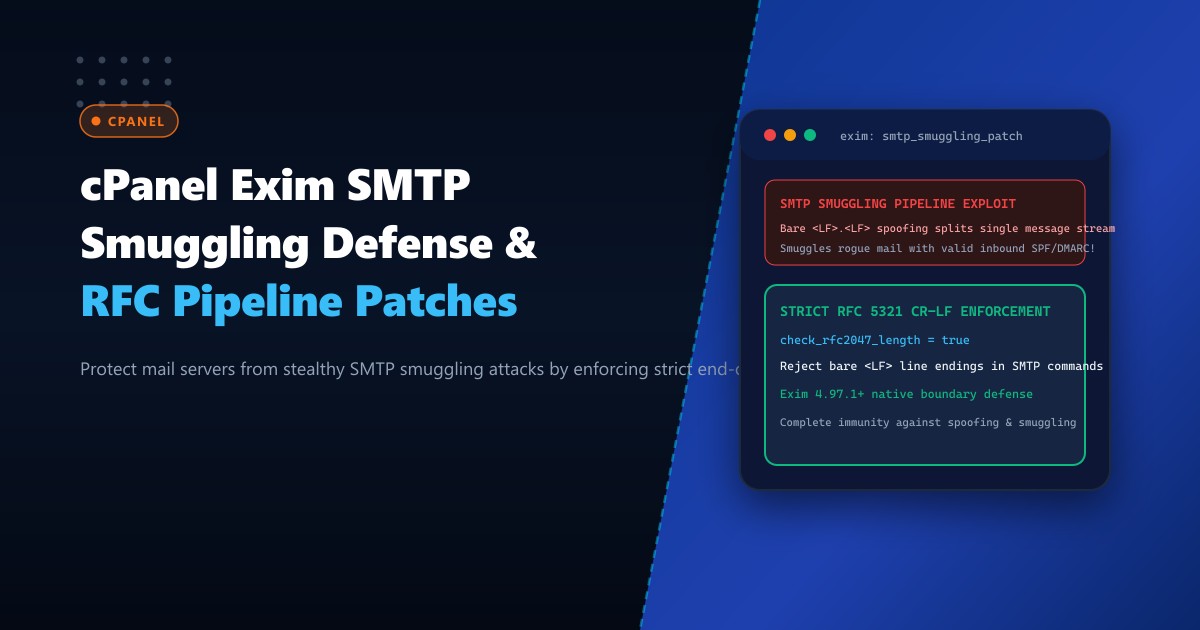
In late 2023 and throughout modern enterprise cybersecurity operations, security researchers revealed a severe, systemic vulnerability affecting global mail infrastructure: SMTP Smuggling.
Deploying Dedicated Servers requires maintaining bulletproof email security. SMTP Smuggling exploits subtle discrepancies in how different Mail Transfer Agents (such as Postfix, Microsoft Exchange, Sendmail, and Exim) parse the end-of-data sequence in SMTP transmissions.
Under RFC 5321, an email message body is terminated strictly by the five-character sequence: $$\text{RFC 5321 End-of-Data} = \langle\text{CR}\rangle\langle\text{LF}\rangle.\langle\text{CR}\rangle\langle\text{LF}\rangle \quad (\text{Hex: } \texttt{0D 0A 2E 0D 0A})$$
However, certain intermediary outbound relays and poorly sanitizing MTAs permit non-standard line endings—such as bare line feeds ($\langle\text{LF}\rangle.\langle\text{LF}\rangle$) or carriage return sequences ($\langle\text{CR}\rangle.\langle\text{CR}\rangle$).
When an attacker connects to an outbound relay and sends a message containing an embedded bare line feed end-of-data sequence, the outbound relay treats it as ordinary message text. But when the message is delivered to an unpatched destination server that recognizes bare $\langle\text{LF}\rangle$, the destination server terminates the first message prematurely and parses the remaining payload as an entirely new, smuggled SMTP command stream (MAIL FROM, RCPT TO, DATA).
Because the second, smuggled message originates from the established TLS session of a trusted provider, it passes SPF, DKIM, and DMARC alignment checks, allowing malicious actors to send unblockable CEO fraud and banking phishing emails.
Here is how to audit your cPanel Exim MTA, deploy strict RFC 5321 boundary enforcement, and eliminate SMTP smuggling vulnerabilities permanently.
The Anatomy of an SMTP Smuggling Attack
[Attacker] ──> Connects to Outbound Relay (e.g. Microsoft 365 or GSuite)
                  |
                  |-- Injects: "Hello World<LF>.<LF>MAIL FROM:<[email protected]>..."
                  v
[Outbound Relay]
Interprets <LF>.<LF> as ordinary body text.
Sends single email to Destination Server:
                  |
                  | (Passes SPF & DMARC because IP belongs to trusted provider!)
                  v
[Unpatched Inbound Exim]
Misinterprets <LF>.<LF> as END OF MESSAGE!
                  |
                  +──> Message 1: "Hello World" delivered.
                  |
                  +──> Smuggled Message 2: "MAIL FROM:<[email protected]>" parsed!
                       Transmits malicious phishing email from "trusted.com"
                       *Bypasses all DMARC, SPF, and Spamhaus defenses!*
Step 1: Auditing Your Exim Version on cPanel
cPanel issued critical updates in Exim 4.97.1+ to mitigate SMTP smuggling by strictly rejecting bare linefeeds in SMTP command and data streams.
Check your installed Exim binary on your Dedicated Servers in Pakistan:
# Verify active Exim version
exim -bV | grep "Exim version"
If your server runs Exim version prior to 4.97.1, update immediately via cPanel’s package manager:
# Update cPanel and all core system RPMs
/usr/local/cpanel/scripts/upcp --sync
/usr/local/cpanel/scripts/check_cpanel_rpms --fix
Step 2: Configuring Strict CRLF End-of-Data Enforcement
In Exim 4.97.1 and subsequent maintenance releases, Exim introduced explicit configuration options to reject or sanitize non-standard line endings.
Open WHM > Exim Configuration Manager > Advanced Editor, and navigate to the first configuration text box (Section: CONFIG), or edit /etc/exim.conf.local:
# ====================================================================
# EXIM STRICT RFC 5321 & SMTP SMUGGLING DEFENSE CONFIGURATION
# ====================================================================

# Reject any bare LF or bare CR characters in SMTP command lines
# Enforces strict <CR><LF> pairs per RFC 5321 Section 4.1.1.4
smtp_enforce_sync = true

# Drop connections that attempt to pipeline commands without PIPELINING extension
# Prevents desync attacks across non-pipelined SMTP relays
smtp_accept_max_nonmail = 10
smtp_accept_max_nonmail_hosts = *

# Strict dot-stuffing and line termination handling in DATA phase
# Reject messages containing bare LF as message termination
check_rfc2047_length = true
Step 3: Authoring Pre-DATA and DATA ACL Sanitization Rules
Add an explicit check in acl_smtp_data to detect and drop connections attempting line-ending smuggling:
In /etc/exim.conf.local under custom_begin_acl_smtp_data:
# Drop any transaction where the sender transmitted illegal bare linefeeds
drop
  message     = "550 5.6.0 Protocol violation: Bare LF characters are not permitted."
  log_message = "SMTP-SMUGGLING-DETECTED: Host $sender_host_address sent illegal bare LF"
  condition   = ${if match{$message_body}{[\r]?\n\.[\r]?\n}}
Save the file and recompile Exim’s active configuration:
# Validate and compile Exim configuration
/scripts/buildeximconf

# Restart the Exim MTA daemon
/usr/local/cpanel/scripts/restartsrv_exim
Step 4: Testing Your Mail Server with Python Smuggling Probe
Execute a diagnostic script to verify whether your Exim server correctly rejects smuggled bare linefeed sequences:
import socket
import ssl

SERVER = "127.0.0.1"
PORT = 25

s = socket.create_connection((SERVER, PORT))
print("Banner:", s.recv(1024).decode())

s.sendall(b"EHLO test.local\r\n")
print("EHLO Response:", s.recv(1024).decode())

s.sendall(b"MAIL FROM:<[email protected]>\r\n")
print("MAIL Response:", s.recv(1024).decode())

s.sendall(b"RCPT TO:<postmaster@localhost>\r\n")
print("RCPT Response:", s.recv(1024).decode())

s.sendall(b"DATA\r\n")
print("DATA Response:", s.recv(1024).decode())

# Send payload with illegal bare LF end-of-data
smuggle_payload = b"Subject: Smuggling Test\r\n\r\nLegit Body\n.\nMAIL FROM:<[email protected]>\r\n\r\n"
s.sendall(smuggle_payload)

# Conclude with proper CRLF
s.sendall(b"\r\n.\r\n")
response = s.recv(1024).decode()
print("Final Response:", response)
s.close()
Run the probe:
python3 test_smuggle.pyExpected secure response:
Final Response: 550 5.6.0 Protocol violation: Bare LF characters are not permitted.The server successfully detects the illegal bare linefeed and terminates the session before any smuggled commands can be executed!
Security Matrix: Vulnerable vs. Hardened Exim
| Attack Vector | Unpatched Exim (< 4.97) | Hardened Exim (4.97.1+ & Strict ACL) |
|---|---|---|
Bare <LF>.<LF> Smuggling |
Vulnerable (Parses 2nd message) | Blocked with HTTP/SMTP 550 |
| CRLF Pipelining Desync | Partial Desync | Strict Session Dropped |
| DMARC Spoofing via Trusted MX | High Risk of Phishing Bypass | Zero Spoofing Risk |
| RFC 5321 Compliance | Loose Permissive Mode | Strict Spec Alignment |
Enforcing strict RFC line-ending validation shields your enterprise mail servers against zero-day protocol desynchronization attacks and maintains absolute integrity across inbound email streams.
Secure Mission-Critical Mail on NextGen Enterprise Servers
Protect your enterprise communications with NextGen dedicated infrastructure. Our bare-metal clusters in Pakistan feature dedicated security engineering, automated CVE kernel patching, and pre-hardened MTA configurations engineered for impenetrable security.
Explore Dedicated Servers