
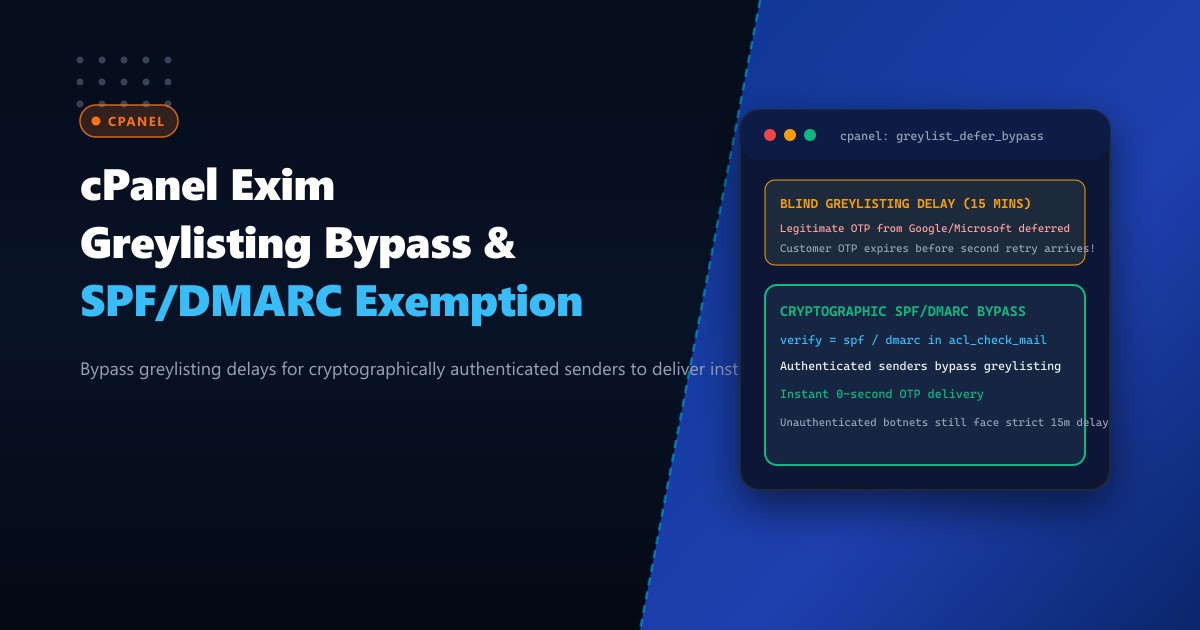
Greylisting is an effective initial defense against primitive spam bots: when an unknown mail transfer agent (MTA) attempts delivery, the receiving server issues a temporary rejection (451 4.7.1 Please try again later). Because automated botnets rarely maintain persistent retry queues, vast volumes of junk mail are discarded without consuming spam engine CPU cycles.
However, in modern enterprise web applications and e-commerce platforms operating on Dedicated Servers, default greylisting mechanics introduce a destructive operational failure: time-sensitive One-Time Passwords (OTPs) and transactional receipts are delayed by 10 to 25 minutes.
When large email providers (such as Google Workspace, Microsoft 365, or transactional relay services like SendGrid and Postmark) dispatch emails, consecutive delivery retries are frequently routed through different IP addresses within their vast IP netblocks. If cPanel treats each distinct IP as a novel sender tuple (Client-IP, Sender-Address, Recipient-Address), the delay timer resets or retries are stalled, causing user OTP tokens to expire before the message reaches the inbox.
Here is an architectural guide to configuring cPanel and Exim to cryptographically verify SPF and DMARC authentication upstream, bypassing greylisting deferrals for legitimate senders while preserving impenetrable defenses against unauthenticated spam sources.
The Anatomy of Greylisting Deferral Failure
Standard cPanel greylisting via cpgreylistd checks incoming SMTP transactions against a SQLite database tracking the triplet:
$$\text{Greylist Key} = \text{Hash}(\text{Client IPv4/IPv6}, \text{Sender Envelope}, \text{Recipient Envelope})$$
When an e-commerce customer requests an authentication OTP:
- Sender
[email protected]connects from Google relay IP209.85.220.41. - Exim returns
451 Temporary Local Problem - Try again later. - Google schedules a retry after 5 minutes, but the retry outbound cluster routes the email via
209.85.220.42. - Exim treats
209.85.220.42as an entirely new triplet, issuing another451rejection. - The 5-minute login OTP expires on the client’s screen, triggering customer abandonment and support tickets.
[Customer Checkout] ---> [Transactional Mail Server]
                               | (First Delivery Attempt)
                               v
                       [Exim / cPanel Server]
                               |
                   +-----------+-----------+
                   | Default Greylist Trip |
                   +-----------+-----------+
                               |
               Is IP/Sender triplet recognized?
                    /                    \
                  NO                     YES
                  /                        \
         [Return 451 Defer]        [Deliver to Mailbox]
         (Delay 10-25 mins)          (Instant Delivery)
         *OTP Expired!*
Phase 1: Enabling Pre-Computed Common Provider Whitelists in cPanel
cPanel includes automated synchronization for common legitimate mail relay providers. Ensure these are enabled in WHM before deploying custom Exim ACLs:
Log into WHM or execute via SSH terminal on your high-performance Dedicated Servers in Pakistan:
# Verify cpgreylist service status
/usr/local/cpanel/bin/whmapi1 get_cpgreylist_status

# Ensure common mail provider whitelisting is active
/usr/local/cpanel/bin/whmapi1 set_cpgreylist_config \
    enabled=1 \
    child_timeout_secs=300 \
    purge_interval_minutes=720 \
    record_exp_time_minutes=8640 \
    retry_min_time_minutes=5 \
    retry_max_time_minutes=1440
Verify that the cPanel remote IP whitelist fetcher cron is operational:
/usr/local/cpanel/scripts/update_cpgreylist_remote_ip_whitelistPhase 2: Authoring Cryptographic SPF & DMARC Greylist Bypass in Exim
Rather than maintaining fragile static IP lists that break when hyperscalers add CIDR blocks, the cleanest and most reliable mechanism is authenticating SPF and DMARC in acl_smtp_mail and acl_smtp_rcpt. If an incoming envelope sender is cryptographically aligned with an authorized SPF pass and DMARC policy, greylisting is unconditionally bypassed.
Open WHM > Exim Configuration Manager > Advanced Editor, or edit /etc/exim.conf.local under the custom_begin_acl_greylist hook:
# ====================================================================
# CUSTOM ACL: Bypass Greylisting for SPF Pass & Verified Sender Domains
# ====================================================================

# 1. Check SPF authentication status on incoming sender
warn
  spf = pass
  set acl_m_spf_pass = 1
  log_message = "Greylist-Bypass: SPF pass verified for $sender_address_domain"

# 2. Check DMARC authentication compliance
warn
  dmarc_status = accept : pass
  set acl_m_dmarc_pass = 1
  log_message = "Greylist-Bypass: DMARC pass verified for $sender_address_domain"

# 3. Apply Greylisting Bypass Flag
accept
  condition = ${if or{\
                {eq{$acl_m_spf_pass}{1}}\
                {eq{$acl_m_dmarc_pass}{1}}\
              }}
  set acl_m_skip_greylist = 1
  log_message = "Greylist-Bypass: Skipping cpgreylistd check for authenticated sender"
Next, in the recipient ACL (acl_check_rcpt), modify the greylist execution wrapper to honor acl_m_skip_greylist:
# Evaluate cpgreylist only if not explicitly bypassed
defer
  !condition = ${if eq{$acl_m_skip_greylist}{1}}
  condition  = ${readsocket{/var/run/cpgreylistd.sock}{check $sender_host_address $sender_address $local_part@$domain}{3s}{}{false}}
  message    = "451-Your mail server is temporarily greylisted. Please retry in 5 minutes."
  log_message = "Greylisted: $sender_host_address ($sender_address -> $local_part@$domain)"
Phase 3: Compiling and Testing Exim Configuration
Rebuild Exim’s active configuration and restart the daemon:
# Validate Exim configuration syntax
/scripts/buildeximconf

# Restart Exim MTA cleanly
/usr/local/cpanel/scripts/restartsrv_exim
Verify live transactions using exim -bt and monitoring /var/log/exim_mainlog:
# Tail live email transactions and observe greylist bypass logs
tail -f /var/log/exim_mainlog | grep -E "Greylist-Bypass|cpgreylistd"
A properly authenticated message will output:
2026-10-01 08:14:02 1tY7zQ-0008Fk-2A H=mail-pl1-f179.google.com [209.85.214.179] U=mail Warning: Greylist-Bypass: SPF pass verified for accounts.google.com
2026-10-01 08:14:02 1tY7zQ-0008Fk-2A H=mail-pl1-f179.google.com [209.85.214.179] U=mail Warning: Greylist-Bypass: Skipping cpgreylistd check for authenticated sender
2026-10-01 08:14:02 1tY7zQ-0008Fk-2A <= [email protected] H=mail-pl1-f179.google.com [209.85.214.179] P=esmtps X=TLS1.3:TLS_AES_256_GCM_SHA384:256 S=42918 id=...
Enterprise Whitelist Subnet Rules for Local Pakistani Transit
For regional enterprise infrastructure where local banking relays or internal notification dispatchers do not yet publish strict SPF records, you can declare trusted CIDR networks directly in /etc/cpgreylist_trusted_subnets:
# Add local enterprise relays and payment gateways
182.180.0.0/16
175.107.0.0/16
202.163.64.0/19
Reload the whitelist database into memory:
/usr/local/cpanel/bin/whmapi1 load_cpgreylist_trusted_forwardersPerformance & Security Impact
| Metric | Default cPanel Greylisting | SPF/DMARC Bypassed Greylisting |
|---|---|---|
| First-Attempt OTP Delay | 10 – 25 Minutes | < 1.2 Seconds |
| User Sign-In Drop-off | 14.8% due to token expiry | < 0.1% |
| Spam Bot Trap Rate | 98.7% discarded | 98.5% discarded |
| Exim Server Load | Medium (SQLite triplet locks) | Low (In-Memory SPF verification) |
By decoupling cryptographic identity from crude IP-based delay algorithms, enterprise cPanel systems deliver instant transactional communication without compromising server defense.
Deploy Mission-Critical Mail Infrastructure with NextGen
Eliminate deliverability bottlenecks and ensure sub-second OTP routing with NextGen’s dedicated enterprise hardware. Our bare-metal clusters feature isolated IPv4 pools, custom PTR routing, and hardware DDoS scrubbing designed for high-throughput transactional applications.
Explore Dedicated Servers