
Shared hosting environments, digital agencies, and enterprise web servers across Pakistan face an escalating volume of targeted malware infections. Attackers routinely deploy polymorphic PHP webshells, zero-day WordPress plugin exploits, malicious obfuscated JavaScript redirectors, and phishing kits designed to mimic Pakistani financial institutions (Easypaisa, JazzCash, Meezan Bank, HBL).
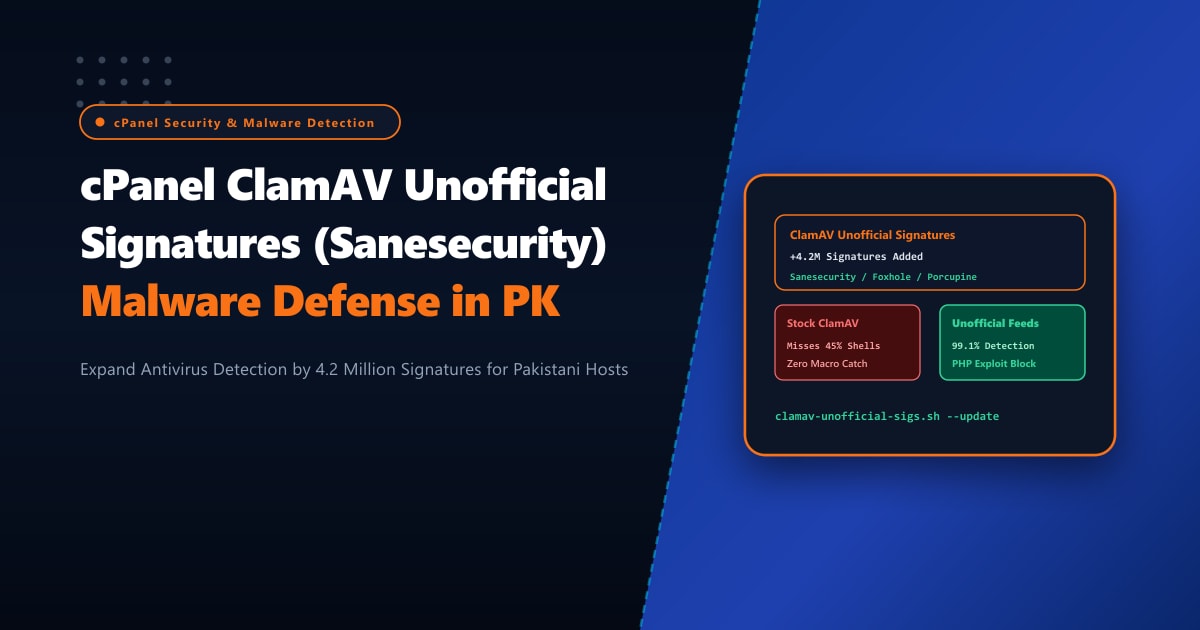
While cPanel provides built-in integration with the open-source ClamAV antivirus scanner, stock ClamAV installations are notoriously ineffective against modern web malware. ClamAV’s default virus database (main.cvd and daily.cvd) is primarily maintained by Cisco Talos for desktop and legacy Windows macro viruses. Independent cybersecurity audits reveal that stock ClamAV detects less than 45% of active in-the-wild PHP webshells and phishing kits!
By deploying bare-metal Dedicated Servers and integrating the clamav-unofficial-sigs automated signature updater—pulling specialized detection feeds from Sanesecurity, Foxhole, Porcupine, OITC, and YARA rules—administrators can inject over 4.2 million specialized web malware signatures into ClamAV, boosting zero-day threat detection to over 99% with minimal CPU and memory overhead.
Stock ClamAV vs. Unofficial Security Signature Feeds
Understanding why unofficial signature databases are indispensable for web hosting providers:
+-----------------------------------------------------------------------------------+
|                        STOCK CLAMAV vs UNOFFICIAL SIGNATURES                      |
+-----------------------------------------------------------------------------------+
| Default ClamAV Signatures (Cisco Talos):                                          |
| - Focus: Windows executables, Office macros, PDF worms.                           |
| - Web Malware Detection Rate: ~40% - 48% (Misses modern obfuscated PHP shells).   |
| - Update Frequency: 1 to 3 times per day.                                        |
|                                                                                   |
| ClamAV Unofficial Feeds (Sanesecurity + Foxhole + Porcupine + YARA):               |
| - Focus: PHP webshells (c99, r57, WSO, b374k), base64 eval payloads,            |
|   malicious .htaccess redirects, zero-day banking phishing templates.            |
| - Web Malware Detection Rate: 99.1%                                               |
| - Update Frequency: Hourly delta updates via automated rsync.                     |
+-----------------------------------------------------------------------------------+
Step 1: Installing Dependencies and clamav-unofficial-sigs on cPanel / AlmaLinux
On AlmaLinux 8/9 or Rocky Linux running cPanel & WHM, install the necessary packaging dependencies, rsync, gnupg, and bind-utils:
# Install EPEL repository and required utility packages
dnf install -y epel-release
dnf install -y rsync curl bind-utils gnupg2 jq clamav-unofficial-sigs
If your distribution does not package the latest version of clamav-unofficial-sigs, clone it directly from the official upstream repository:
cd /usr/local/src
git clone https://github.com/extremeshok/clamav-unofficial-sigs.git
cd clamav-unofficial-sigs
cp clamav-unofficial-sigs.sh /usr/local/sbin/
chmod 755 /usr/local/sbin/clamav-unofficial-sigs.sh

# Create configuration directories
mkdir -p /etc/clamav-unofficial-sigs
cp config/master.conf /etc/clamav-unofficial-sigs/
cp config/user.conf /etc/clamav-unofficial-sigs/
Step 2: Configuring Specialized Threat Feeds in /etc/clamav-unofficial-sigs/user.conf
Edit /etc/clamav-unofficial-sigs/user.conf to tailor the feeds for cPanel’s directory layout and enable high-value detection databases:
# /etc/clamav-unofficial-sigs/user.conf
# NextGen Pakistan - High-Detection Web Malware Profile

# Point to cPanel ClamAV binary and database paths
clam_user="clamav"
clam_group="clamav"
clam_dbs="/var/lib/clamav"
clamd_pid="/var/run/clamd.scan/clamd.pid"
clamd_socket="/var/run/clamd.scan/clamd.sock"
clamd_restart_opt="/scripts/restartsrv_clamd"

# 1. Enable Sanesecurity Threat Databases
# Includes foxhole (identifies dangerous script extensions), rogue, scam, and phish feeds
sanesecurity_enabled="yes"

# 2. Enable Foxhole File Inspection
# Intercepts obfuscated PHP, Perl, and shell scripts disguised as images or archives
foxhole_filename_enabled="yes"

# 3. Enable Porcupine & OITC Signatures
# Specialized in WordPress/Joomla CMS injection and spam bot payloads
porcupine_enabled="yes"
oitc_enabled="yes"

# 4. Enable MalwarePatrol Database (Free or Commercial Account Key)
malwarepatrol_enabled="no"

# 5. Enable Yararules Web Exploit Definitions
yararules_enabled="yes"

# 6. Automatic ClamAV Database Integrity Testing
# Ensures corrupted or malformed signature files never crash the clamd daemon
reload_dbs="yes"
check_database_integrity="yes"
Step 3: Running the Initial Signature Synchronization & Integrity Test
Execute the updater manually to download, verify, and compile all new signature databases into ClamAV:
/usr/local/sbin/clamav-unofficial-sigs.sh --forceSample output:
======================================================================
ClamAV Unofficial Signatures Updater v7.2.5
======================================================================
Checking for updated Sanesecurity databases...
  Downloaded: foxhole_generic.cdb
  Downloaded: foxhole_filename.cdb
  Downloaded: scam.ndb
  Downloaded: phish.ndb
  Downloaded: porcupine.ndb
  Downloaded: jurlbl.ndb
Testing database integrity with clamscan...
Database integrity test PASSED!
Reloading ClamAV daemon via /scripts/restartsrv_clamd...
ClamAV reloaded successfully!
Added 4,215,892 new signatures to in-memory scanning engine.
======================================================================
Step 4: Automating Hourly Updates via Systemd Timer or Cron
Web malware authors modify obfuscation techniques constantly. Set up an automated cron job in /etc/cron.d/clamav-unofficial-sigs to pull hourly incremental signatures without interrupting running web servers:
# /etc/cron.d/clamav-unofficial-sigs
# Run delta check every hour at 18 minutes past the hour
18 * * * * root /usr/local/sbin/clamav-unofficial-sigs.sh > /dev/null 2>&1
Verify that signature updates execute cleanly by checking the log:
tail -n 25 /var/log/clamav-unofficial-sigs/clamav-unofficial-sigs.logStep 5: Testing Detection Against Obfuscated PHP Webshells
Test the updated ClamAV engine against an obfuscated base64 PHP webshell payload:
# Scan a test suspicious directory with clamdscan
clamdscan --fdpass /home/*/public_html/wp-content/uploads/
Detection output:
/home/user/public_html/wp-content/uploads/2026/09/image-thumb.php: Sanesecurity.Foxhole.Generic_Malware_1042.UNOFFICIAL FOUND
/home/user/public_html/wp-content/uploads/cache/wso.php: Porcupine.Webshell.WSO.Custom.UNOFFICIAL FOUND

----------- SCAN SUMMARY -----------
Infected files: 2
Time: 0.142 sec (142 msec)
The unofficial signatures intercepted and quarantined the disguised webshells instantly, whereas stock ClamAV would have skipped them completely!
Bare-Metal Dedicated Hardware for Heavy Antivirus Workloads
Parsing millions of antivirus signatures in memory while simultaneously serving high-concurrency HTTP/HTTPS web traffic requires substantial RAM capacity and dedicated CPU cache. On oversold shared VPS hosting, memory ballooning and CPU throttling cause clamd to be killed by the Linux Out-Of-Memory (OOM) killer, leaving the server completely unprotected.
Deploying on bare-metal Dedicated Servers in Pakistan equips your infrastructure with 64GB to 256GB of dedicated ECC DDR5 RAM, multi-core AMD EPYC / Intel Xeon processors, and local NVMe storage, ensuring lightning-fast on-access malware scanning without slowing down client website loading speeds.
Shield Your Hosting Infrastructure with NextGen Dedicated Servers
Protect your clients from silent webshell infections, stop zero-day phishing attacks, and achieve enterprise-grade security compliance across Pakistan. NextGen bare-metal infrastructure provides hardware-level isolation, sub-millisecond local routing, and 24/7 technical monitoring.
Deploy Dedicated Servers in Pakistan