
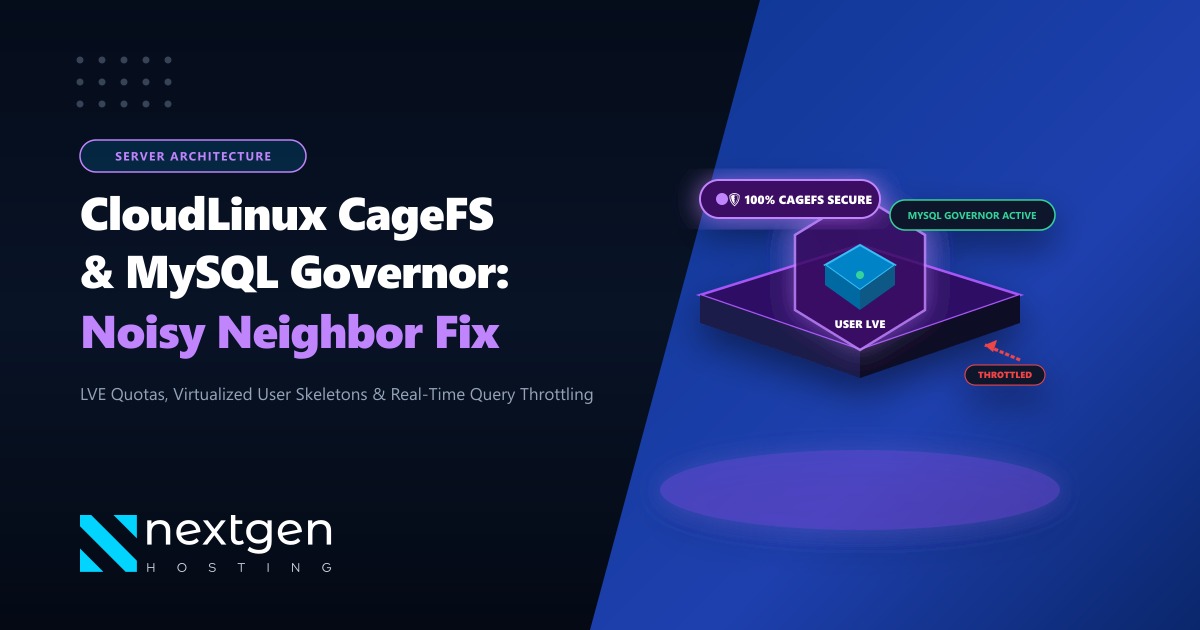
In traditional multi-tenant Linux hosting, a single compromised or misconfigured website can bring down an entire server housing hundreds of other businesses.
A single tenant runs an unindexed SQL query that locks up MariaDB, another tenant gets hit by a volumetric DDoS attack that floods the network socket, and suddenly, every customer on that machine suffers downtime. This is the infamous “Noisy Neighbor” phenomenon.
To solve this systemic flaw, enterprise hosting providers in Pakistan deploy CloudLinux OS augmented with two mission-critical kernel innovations: CageFS and MySQL Governor.
CageFS virtualizes each tenant into an isolated, chrooted file system where they cannot see or access other users’ files, while MySQL Governor monitors database queries in real time, throttling abusive scripts before they can exhaust CPU and memory pools.
Here is an architectural deep dive into how CloudLinux CageFS and MySQL Governor protect shared and reseller hosting servers in 2026.
Core Architectural Principles
- CageFS Virtualized User Skeletons: CageFS mounts a private, virtualized copy of system binaries (
/bin,/usr,/lib) for each cPanel account, completely hiding server configuration files, password hashes, and neighboring account directories. - MySQL Governor Real-Time Throttling: Uses kernel-level Cgroup hooks to track CPU and disk I/O per MySQL user. When an account exceeds predefined thresholds, Governor automatically throttles their query execution speed rather than crashing the database daemon.
- Predictable LVE Quotas: Lightweight Virtual Environments (LVE) enforce strict limits on CPU percentage, physical RAM, I/O bandwidth, and simultaneous entry processes, preventing server-wide cascading failures.
- Zero Cross-Contamination: Even if a website on the server is hacked with a rootkit or PHP web shell, the attacker is jailed inside their own CageFS filesystem with zero visibility into system processes.
1. How CageFS Works: The Virtualized Chroot Prison
Unlike traditional shared Linux hosting where all users share the same physical filesystem and can view /etc/passwd, CageFS isolates each user into their own private jail:
TRADITIONAL LINUX MULTI-TENANT:
/home/
  |--> /clientA/ (Can see /etc/, /tmp/, and other processes via ps aux)
  |--> /clientB/ (Vulnerable to cross-account directory traversal!)

CLOUDLINUX CAGEFS ARCHITECTURE:
[ Master Root Filesystem (Bare-Metal Host) ]
  |
  +--> [ CageFS Skeleton Template: /usr/share/cagefs-skeleton ]
         |
         +--> Mounts read-only virtual system views via per-user namespaces:
                |--> [ Client A Jail ] -> Sees only /home/clientA & dummy /etc
                |--> [ Client B Jail ] -> Sees only /home/clientB & dummy /etc
Key Security Benefits:
- Hidden Process Table: When a user executes
ps auxinside terminal, they can only see their own running processes. They cannot view Apache, Nginx, or other users’ commands. - Sanitized
/tmpand/var/tmp: Each user receives their own isolated/tmpdirectory, preventing symlink race condition exploits. - Protected Configuration Files: Sensitive files like
/etc/named.confor/etc/my.cnfare replaced with sanitized dummy copies inside the user’s cage.
2. MySQL Governor: Stopping Database Starvation in Real-Time
In a traditional hosting setup, MySQL/MariaDB runs as a single monolithic service. If Client A executes an unindexed query across 5 million rows, MySQL allocates 100% of its worker threads to Client A, causing queries from Clients B, C, and D to queue up and timeout.
MySQL Governor operates between the database engine and the Linux kernel scheduler to enforce real-time fair share:
+---------------------------------------------------------------+
|                    INCOMING DATABASE TRAFFIC                  |
+---------------------------------------------------------------+
                               |
                               v
+---------------------------------------------------------------+
|                   CLOUDLINUX MYSQL GOVERNOR                   |
|  Tracks real-time CPU% and Disk I/O per database username     |
+---------------------------------------------------------------+
         |                                             |
   [ Normal Query ]                           [ Rogue Runaway Query ]
   (Under 20% CPU Limit)                      (Exceeds 70% CPU for >30s)
         |                                             |
   Executes Instantly in <5ms                          v
                                              AUTOMATICALLY THROTTLED
                                              Assigned to Low-Priority LVE
                                              Other Users Experience ZERO LAG
Governor Throttling Modes:
- SINGLE Mode: Throttles only the abusive query while allowing other queries from the same user to run normally.
- ALL Mode (Default): Temporarily throttles all queries for the offending cPanel user, giving them a cooldown period to prevent server-wide memory exhaustion.
# Check real-time MySQL Governor activity via SSH
dbtop

# Output shows exact CPU and I/O consumption per user:
# USER        CPU%    IO%    MEM%    STATUS
# client_a    12.4    4.2    1.8     OK
# client_b    84.6   68.2    4.5     THROTTLED (Slowed down safely)
3. Configuring Production LVE Limits (lvectl)
Server administrators can calibrate resource limits on a per-package or per-user basis using the lvectl command line tool:
# Set limits for package 'Standard-Hosting':
# - 1.5 vCPU Cores (150%)
# - 2GB Physical RAM
# - 20MB/s I/O Bandwidth
# - 30 Concurrent Entry Processes
lvectl set-pkg Standard-Hosting --speed=150% --pmem=2048M --io=20480 --ep=30 --nproc=100
When an account reaches its physical memory (PMEM) limit, CloudLinux terminates only that account’s excess child process, throwing a localized 508 Resource Limit Reached error without impacting neighboring websites.
4. Hardware Scaling: Dedicated Virtualization & Bare-Metal Nodes
While CloudLinux is the undisputed champion for multi-tenant shared hosting, enterprise platforms that have outgrown shared limits require true hardware sovereignty.
When your application consistently requires 8 to 16 dedicated CPU cores and 32GB+ of guaranteed RAM, operating inside a shared LVE cage introduces artificial throttling limits that restrict growth.
For large software export agencies, fintech APIs, and high-concurrency SaaS apps, moving to global Dedicated Servers eliminates all hypervisor and LVE constraints, giving your engineering team raw bare-metal access to AMD EPYC processors and enterprise NVMe storage arrays.
If your platform processes domestic banking, logistics, or government data under national compliance guidelines, hosting on Dedicated Servers in Pakistan guarantees sub-10ms domestic routing over PTCL, Nayatel, and StormFiber backbones with local PKR billing and 24/7 dedicated enterprise support.
5. CloudLinux Health & Security Checklist
| Feature | Production Setting | Operational Purpose |
|---|---|---|
| CageFS | Enabled Server-Wide | Enforces per-user chrooted filesystem isolation |
| MySQL Governor | Active (mode = all) |
Prevents database starvation from runaway queries |
| PHP Selector | MultiPHP Active | Allows users to choose PHP 8.1, 8.2, 8.3, or 8.4 safely |
| ModSecurity + Imunify | Active WAF Rules | Blocks SQL injections and zero-day web exploits |
| Inode Quotas | Enforced per Account | Prevents disk space exhaustion from mail loops |
Host Your Websites on 100% Isolated Cloud Infrastructure
Experience bulletproof server stability with Nextgen Hosting. Pure NVMe storage, CloudLinux CageFS isolation, MySQL Governor protection, 99.9% uptime SLAs, and 24/7 technical support in Pakistan.
