
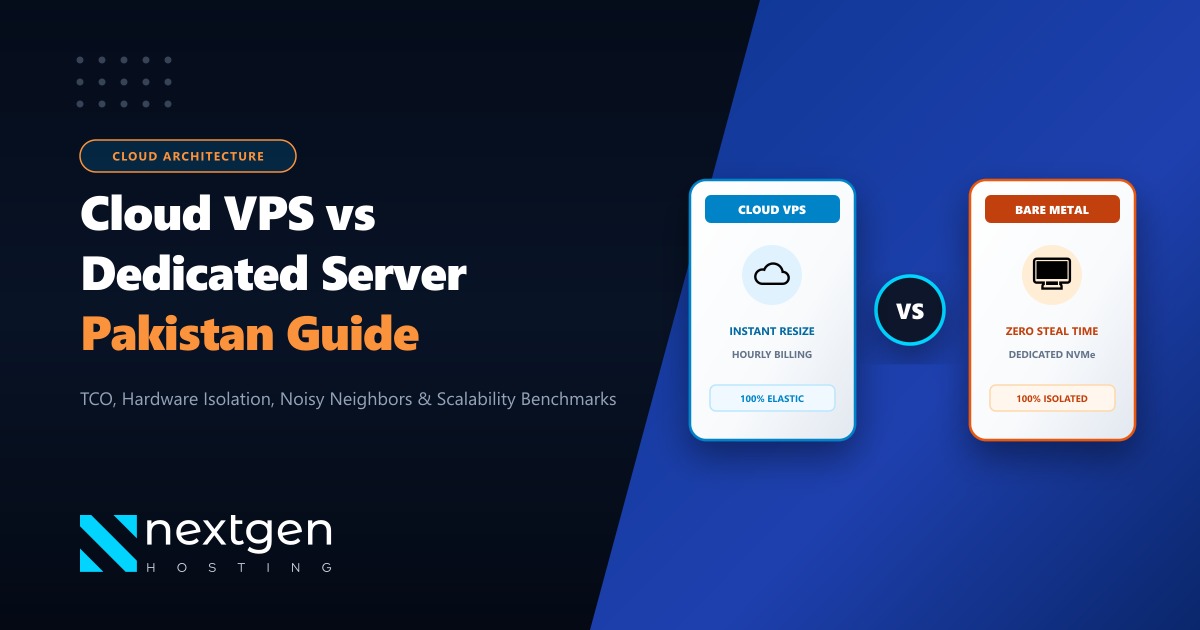
When scaling a digital platform in Pakistan beyond basic shared hosting, engineering teams inevitably face an architectural fork in the road: Should you deploy on a Cloud VPS or lease a Bare-Metal Dedicated Server?
Both options deliver root SSH access, private IP addresses, and isolated environments far superior to shared hosting. Yet, they serve radically different operational models:
- Cloud VPS offers rapid elasticity, instant vertical scaling, and cost-effective entry points.
- Bare-Metal Dedicated Servers provide raw, unthrottled computing power with zero hypervisor virtualization overhead and absolute hardware isolation.
For Pakistani businesses navigating fluctuating exchange rates, unpredictable network traffic spikes, and strict data compliance rules, making the wrong choice leads either to overpaying for idle computing power or suffering database bottlenecks under heavy loads.
Here is your comprehensive architectural and financial comparison of Cloud VPS vs. Dedicated Servers in Pakistan.
Executive Comparison Summary
- Virtualization vs. Bare Metal: Cloud VPS runs on top of a hypervisor (KVM/Proxmox) sharing physical hardware with other virtual machines; a Dedicated Server provides 100% exclusive access to the underlying motherboard, CPU, and NVMe drives.
- Zero CPU Steal Time: On dedicated servers, CPU steal time (`%st`) is strictly 0.0%, ensuring consistent sub-millisecond database query performance without interference from neighboring workloads.
- Scalability Speed: Cloud VPS can be upgraded with 2 extra vCPUs and 4GB RAM in 60 seconds with a simple reboot; dedicated servers require scheduled hardware maintenance to physically add RAM or swap drives.
- Cost Break-Even Point: For workloads requiring up to 16GB RAM and 8 vCPUs, Cloud VPS is significantly more economical; for workloads exceeding 64GB RAM and 16 cores, dedicated bare metal delivers a drastically lower Total Cost of Ownership (TCO).
1. Architectural Deep Dive: Virtualization vs. Physical Silicon
To understand the performance differences, examine how computing instructions reach the physical processor:
[Cloud VPS Virtualized Stack]
User App ──► Guest OS (Ubuntu) ──► KVM Hypervisor ──► Host OS Kernel ──► Physical CPU / NVMe
(Trade-off: ~3-5% virtualization overhead | Potential CPU steal time during host spikes)

[Dedicated Bare-Metal Stack]
User App ──► Native Linux OS (Ubuntu) ──► Direct Physical Silicon (AMD EPYC / Intel Xeon)
(Advantage: 0% virtualization overhead | Direct PCIe 4.0/5.0 bus access | 100% predictable latency)
The “Noisy Neighbor” Factor
On a Cloud VPS, your virtual CPU cores are scheduled by the host kernel. While modern hypervisors strictly enforce fair scheduling, intensive disk I/O bursts on neighboring instances can occasionally introduce micro-delays (known as I/O wait).
On a Bare-Metal Dedicated Server, you own the entire PCIe storage controller, memory bus, and network interface card (NIC). There are no neighbors, no hypervisors, and zero resource contention.
2. Hardware & Feature Comparison Matrix
| Feature | Cloud VPS (Nextgen NVMe) | Bare-Metal Dedicated Server |
|---|---|---|
| Hardware Access | Virtualized vCPU & Virtual Disks | Direct Bare-Metal Access (Raw Silicon) |
| CPU Steal Time (%st) | 0% – 1.5% (Enforced KVM Fair Share) | Strictly 0.0% (Zero Contention) |
| Storage Speed | Enterprise NVMe (~3,500 MB/s) | Hardware RAID NVMe (~7,000+ MB/s) |
| Deployment Time | Instant (Under 60 seconds) | 1 to 4 hours (Hardware burn-in) |
| Vertical Scalability | Instant 1-Click Upgrade | Requires manual hardware component swap |
| Root & BIOS Access | Full OS Root; No BIOS/IPMI | Full OS Root + Dedicated IPMI / KVM-over-IP |
| Custom Kernel Modules | Supported on KVM | Full Unrestricted Kernel & Virtualization (Proxmox/ESXi) |
| Pricing Entry Point | Budget-Friendly (From Rs. 1,500/mo) | Enterprise Scale (From Rs. 25,000/mo) |
3. Total Cost of Ownership (TCO) in Pakistan
When calculating server costs, many Pakistani IT managers look only at the monthly base fee without calculating resource unit efficiency:
- The Startup / Growth Phase (1GB – 32GB RAM): A Cloud VPS is vastly more economical. You only pay for what you currently need, starting at Rs. 1,500 to Rs. 8,000 per month, scaling up as traffic grows.
- The Enterprise / High-Volume Phase (64GB – 256GB RAM): If you attempt to provision a 128GB RAM Cloud VPS with 32 vCPUs on public hyper-scalers (such as AWS or Google Cloud), monthly costs routinely exceed $600 to $1,000 (over Rs. 180,000 to Rs. 280,000/mo). A high-performance Bare-Metal Dedicated Server delivers the exact same 128GB RAM and 32 physical cores at a fraction of the cost, saving millions of rupees annually.
4. Selecting the Right Infrastructure for Your Workload
-
Choose Cloud VPS If:
- You run startup websites, medium WordPress/WooCommerce blogs, SaaS staging environments, or API gateways.
- You need rapid elasticity and the ability to scale resources up or down with zero notice.
- You prefer automated hypervisor snapshot backups and rapid disaster recovery templates.
-
Choose Bare-Metal Dedicated Server If:
- You operate high-volume database clusters (PostgreSQL, MySQL, MongoDB, Redis) processing thousands of concurrent transactions.
- You run a private virtualization cluster (deploying your own Proxmox, VMware ESXi, or OpenStack node).
- You require unmetered high-bandwidth streaming, video transcoding, or machine learning pipelines.
For organizations demanding dedicated physical computing power with enterprise hardware warranties and 99.99% network uptime SLAs, our global Dedicated Servers provide unmetered 1Gbps ports with enterprise Intel Xeon and AMD EPYC silicon.
If your regulatory framework (such as SBP banking mandates or national data residency laws) requires servers to operate strictly within domestic borders, our Dedicated Servers in Pakistan provide local datacenter hosting in Karachi and Lahore with sub-10ms domestic latency.
Find the Perfect Compute Platform for Your Business
Whether you need an elastic Cloud VPS or raw bare-metal dedicated power, Nextgen Hosting delivers pure NVMe storage, 99.9% uptime SLAs, and 24/7 technical support in Pakistan.
